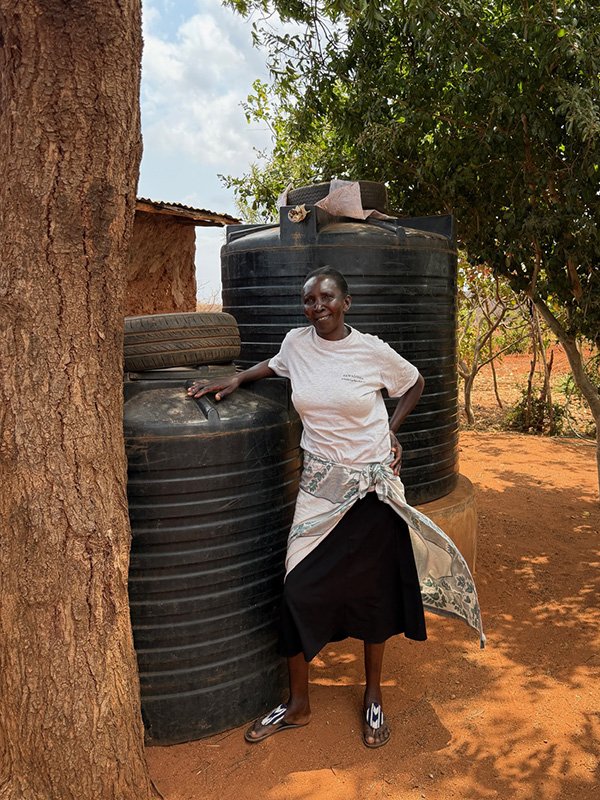
Jane’s rainwater tanks have changed her life.
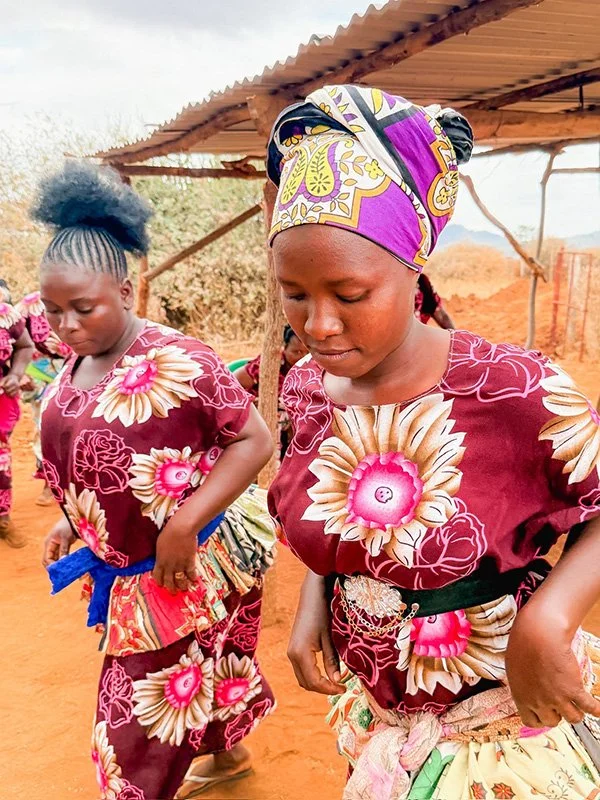
Welcome dance from the women of Maungu.
August 2026
Jane is a tall, slender middle-aged Taita woman in the small community of Maungu, Kenya. She is a wife, mother and grandmother. She is also a farmer, basket-weaver and senior loan-advisor.
Her home is made of hand-made mud bricks. Her roof is a series of corrugated steel sheets. Inside, a small cookstove sits on a concrete floor. The room is lit by a single bulb, powered by solar panels. Outside, three massive water tanks catch rainwater and irrigate her ten acres of lentils.
Jane stands in front of her home, beaming.
“Even though I’m old,” she says in Swahili through a translator. “I’m literally glowing. I close my eyes, and I feel I’m just dreaming.”
The day we visited Jane and heard her story reminded me why I decided six years ago that when I’m fortunate enough to travel, I want to do it with a purpose.
So I looked for ways to explore and learn without being a consumer-only tourist. I found a thing called volunteerism. You go anywhere in the world and do something worthwhile in the areas such as teaching and childcare, wildlife and conservation, community development, women’s empowerment.
I chose wildlife and conservation in Africa and went twice.
This year’s trip, also in Africa, focuses on culture and enfranchising women. And that’s how I met Jane.
Jane is a beneficiary of Zawadisha, a little-known non-profit that provides micro-loans to women of Maungu for simple but life-changing household items.
With each small loan, Jane was able to make incremental improvements in her family’s life and put her land to use.
She paid off each loan “lipa mdogo mdogo” (little by little) enabling her to take another. Eventually, Jane was hired to teach money management and the process and responsibility of taking a loan.
Zawadisha was founded 15 years ago by Jen Gurecki of Reno, Nevada, after meeting the women of Maungu while doing research for her master’s degree.
“Rural Kenyan women are forever striving to raise their families out of poverty,” said Jen. They bear the brunt of the health risks and time-consuming hardships. That’s where the micro-loans help.”
Jen took us to Maungu to meet the women, cook and eat with them, learn how to weave baskets and, if we were so inclined, to shop the Zawadisha store for their artesian work – handwoven baskets, jewelry made from paper, paper made from elephant dung, intricate beadwork, and more.
A few years back, Jen helped the women see the value of their work and offer their items for sale in their local shop as well as on Zawadisha’s website. The proceeds of these sales plus the two annual trips Jen leads through Kenya all support the women.
Though Jen’s work is to loan – not give – money, she named her organization Zawadisha, which means to give a gift in Swahili.
To Monica Makori, former CEO and Jen’s long-time partner on the ground, the name couldn’t be more apt.
“Zawadisha gives our women dignity,” she says. “There is no greater gift than that.”